Liner Notes
Looking back on Steve Coleman’s recorded output over the past dozen years and listening to this new two-CD set, I’m reminded of poet Jay Wright’s remark, following one of his readings, to an audience member who commented that Wright seemed to be trying to weave together a lot of different things. “They are already woven,” he answered, “I’m just trying to uncover the weave.” Steve Coleman, as his more recent recordings make more and more clear, is involved in a similar undertaking; he returns to one of music’s most ancient callings, the intimation of otherwise unapparent connection. The range and array of musical idioms encompassed both over the course of Coleman’s career to date and, increasingly, within the confines of a single recording or composition are stunning evidence of an integrative weave, yet that weave entails more than simply a musical mix. Modal, bebop, harmolodic, big band, free, funk, R&B and Hip Hop variants mingle and mesh not only with one another but also with cross-cultural elements emanating from Africa (Maghrebi and sub-Saharan), Cuba, Japan, the Indian subcontinent and elsewhere; a synthesis which is noteworthy in strictly musical terms but also meant to advance a sense of larger integration.
As it is for most musicians within the African American improvisatory tradition, music for Coleman is more than entertainment. “It is my wish,” he says, “to be a force to help bring to our society an expanded awareness of how to be in tune to the natural rhythms of the universe.” Such an aim admits him to an ages-old understanding of music’s vocation as one of cosmic attunement, a tradition in which recent figures as different as John Coltrane, Inayat Khan and Olivier Messiaen come to mind but which goes back to ancient figures like Pythagoras and even farther back. The latter’s Egyptian catechisms are especially relevant to Coleman, for whom the study of ancient Nile Valley civilizations has been central in recent years. “The main area of focus of my work has been Ancient Egyptian Cosmogony and Knowledge,” he points out. “Since much of this information is lost or distorted, I have researched other ancient cultures that are extant today, such as Yoruba, Dagbon (Ghana), Ngbe (through the Abacuá in Cuba), ancient Hebrew, ancient Greek, Vedic, Sumerian (Mesopotamia), etc., as well as some of the Mystery School systems in existence today. I try to express this information through my music much in the same way as ancient architectures expressed this knowledge through Sacred Geometry.” As titles such as “Pi” and “Law of Balance” on the present recording indicate, ancient conjugations of number and proportion within music freighted with esoteric import initiate the lineage he relates himself to.
Titles tell. Motherland Pulse, On the Edge of Tomorrow and World Expansion (The M-Base Neophyte), the titles of Coleman’s first three albums, limn the beginnings of an evolving concept which looks to the future as well as the past, inward and outward as well, advancing a prodigious rhythmic disposition which, rooted in transplanted Africanity, seeks and sows global resonances. Sine Die, Latin for “without date” and the title of his fourth album, accents and makes more explicit a concern with timelessness, eternity, the universal. Rhythm People (The Resurrection of Creative Black Civilization) and Black Science, the titles of his fifth and sixth albums, speak for themselves. And so it goes, through nine more releases, counting the present two-CD set. What these titles reveal, among other things, is a strikingly literate sensibility, contrary to images of the black improviser as a creature of raw, nonreflective instinct. The names Coleman gives his various groups; Five Elements, Metrics, The Mystic Rhythm Society, Renegade Way, The Secret Doctrine, The Council Of Balance; tell as well, asserting nothing if not that the pooling of schooled impulse is what his music is about. Strata Institute, the band he formed with saxophonist Greg Osby, and the M-Base Collective, a musicians’ association of which he is a founding member, carry names denoting organizing principles which are readily audible in the music itself. The liner notes to the former’s album Cipher Syntax spell things out, specifying strata to be “a series of layers, levels of gradation in an ordered system,” and institute to be “an organization for the promotion of a cause.” M-Base, Coleman points out, is an acronym for “Macro-Basic Array of Structured Extemporizations.” “For us,” he goes on to explain, “this means expressing our experiences through music that uses improvisation and structure as two of its main ingredients. There is no limitation on the kind of structures or the type of improvisation or the style of the music. The main goal is to creatively express our experiences as they are today and to try and build common creative musical languages in order to do this on some kind of large collective level (macro, basic, array).”
There’s no richer achievement of this goal among Coleman’s recordings than the present set of two CDs, the first an extended composition for a very large group called The Council Of Balance and the second a set of compositions performed by a smaller band, Five Elements. The M-Base Collective’s founding principle of “improvisation within nested looping structures” is abundantly in evidence throughout the recording, brought to a degree of imposing majesty and moment. Coleman says that the subject of the first CD “is basically the symbolic meaning of the seven days of Creation” and that the second “is concerned primarily with the concept of growth and regeneration.” The relationship between the two calls to mind Mircea Eliade’s idea that homo religiosus, through ritual, periodically returns to the time of origins, that such ritual evokes and partakes of cosmogonic time as the model for all sacred times if not for sacredness itself; the return to Creation, sacred time, renews the resolve, strength and creativity needed to negotiate profane duration. Hence, on the present recording, the transition from the bottom-rich quiet and the exultant verticalities of “Day Seven” to the strutting, R&B-like tag of “Awareness,” on which, as prelude to the second CD, the first CD fades. That strut, modeling itself on creation ex nihilo, speaks of what Zora Neale Hurston calls “making a way out of no-way,” just as Bob Marley, asked in an interview how long he’d been singing, answered, “From Creation.” Such affirmative spirit runs throughout both CDs. Epiphany rides rhythm and pitch in an often densely woven music of great propulsive beauty, multiple resonance and reach.
Nathaniel Mackey
Credits
Personnel (* = also on The Opening of the Way)
Saxophones: Steve Coleman* (as), Greg Osby (as), Ravi Coltrane (ts & ss), Aaron Stewart (ts), Yosvany Terry Cabrera (ts) and Greg Tardy (ts)
Trumpet: Ralph Alessi, Shane Endsley and Nbate Isles
Trombone: George Lewis, Tim Albright, Josh Roseman, André Atkins and Jamal Haynes
Guitar: David Gilmore (on Day One and Day Two only)
Piano: Andy Milne* (except on “Day Seven”)
Keyboards: Vijay Iyer (piano on “Day Seven”)
Bass: Kenny Davis and Regg Washington*
Drums: Sean Rickman* and Gene Lake (Day Four, Day Six, Awareness)
Percussion: Luis Cancino Morales (bata: Itótèlée and congas), Ramón García Pérez (bata: Ìyá and congas), Josh Jones (bata: Okonkolò), Miguel “Anga” Diaz Zayas* (congas) and Barbaro Ramos Adazabar (clave)
Strings: Elektra Kurtis-Stewart and Marlene Rice (violin), Judith Insell (viola) and Nioka Workman (cello)
Genesis recorded at Systems Two Recording Studio, Brooklyn, NY on April 24-27, 1997 and June 9, 10 & 18, 1997.
The Opening of the Way recorded at Systems Two Recording Studio, Brooklyn, NY on March 7-10, 1997. Additional recording at Studio Acousti in Paris France on November 18, 1996.
Mixed August 1997 at Systems Two Recording Studio in Brooklyn, NY.
Mastered by Ted Jensen at Sterling Sound, NYC on August 18, 1997.
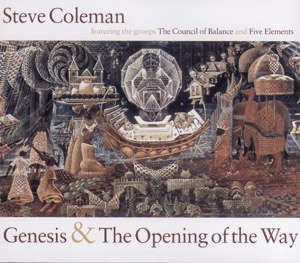
Cover Art: John Biggers
Track List (Genesis)
- Day One 09:03
- Day Two 10:17
- Day Three 05:36
- Day Four 08:33
- Day Five 07:13
- Day Six 09:59
- Day Seven 13:48
- Awareness 03:51
Track List (The Opening of the Way)
- Law of Balance 06:50
- Pi 06:48
- First Cause 04:31
- Wheel of Nature 06:13
- Rite of Passage 07:04
- Regeneration 11:43
- Organic Movement 02:55
- The Law 07:21
- Fortitude and Chaos 04:46
- Seti I 05:14
- Polar Shift 07:24
- Third Dynasty 04:37
All songs written by Steve Coleman and published by Goemon Publishing Co.(SESAC/GEMA).
Special thanks to Carolina Sanchez, The World Music Institute, Ken Fredenberg of Toca Percussion, Bill Martinez, Tom Goodwin and Rosangela Silvestre.
Steve Coleman plays Vandoren mouthpieces and reeds.
Download
Music available on the download page.