Introduction: Balance
We live in a world of immense beauty. There are a multitude of forms with countless variations on simple themes. I want to speak here about balance and make some comments about how balance can be achieved musically. There are countless ways that architectural balance can be musically achieved from the micro to macro level. Since attention to detail has always been an important factor for me, and these things are not usually discussed, I would like to initiate some dialog on this subject. The most obvious kinds of balance that come to mind are the various forms of symmetry (i.e. bilateral, etc.) that can be applied musically, using intuitive and logical methods. Symmetry is a fact of nature and one of the oldest fascinations of humanity. Some of the more obvious ways in which symmetrical musical balance could be realized are through melody, rhythm, tonality, form, harmony and instrumentation. As well as the structural considerations of symmetrical musical forms I will also discuss these structures from a dynamic point of view, i.e. as they progress through time.
Melodic material generated by symmetrically derived laws of motion
This theory was originally a melodic theory, created by me in 1978 (and periodically updated). I named it Symmetry because the motion of the melodies involves an expansion and contraction of tones around an axis tone or axis tones (i.e. around a center point). The expansion and contraction involved is almost always equal on both sides of the axis, hence the term Symmetry. This is basically a melodic system that obeys it’s own laws of motion. It moves according to the gravity of this motion more than anything else but it can also be adapted to deal with the gravity of other types of tonality such as cells or the traditional dominant-tonic harmonic system. When I first started dealing with symmetry I only dealt with the laws of motion produced by the system without any regard for other types of tonality. This is how I would suggest others to learn the system to get a feel for thinking in these terms. Also a complete knowledge of intervals and their relationships (always thinking in terms of semi-tones) would be extremely helpful.
I began in 1978 by writing symmetrical exercises for myself. Then I practiced these exercises to get my fingers and ears used to moving and hearing these ideas. It was only after doing this that I practiced improvising within these structures playing at first in an open manner (not based on any outside structure such as a song). Later I adapted these improvisations to structures and forms. I did this by slowly integrating the ideas with the more traditional improvisational style I was already playing. My goal was not to play in a totally symmetrical style (as this would be as boring as playing all major scales) but to integrate the style and give myself more options when I improvise.
The basic system involves what I call two spirals. They are tones that move out equally in half steps from an axis (which is always at least two tones).
If the axis of the first spiral is the two tone C-C unison (one octave above middle C, it could be in any octave) then from that unison C, you move out (spiral out) each tone in a different direction in half steps, i.e. C-C, then B on the bottom and C sharp on the top; B flat on bottom and D on top; A on bottom and D sharp on top; A flat on bottom and E on top; G on bottom and F on top; G flat on bottom and F sharp on top (at this point you are at the beginning of the spiral again, or the symmetrical mirror image of the spiral); F on bottom and G on top; E on bottom and G sharp on top; E flat on bottom, A on top; D on bottom and A sharp on top; D flat on bottom and B on top; C on bottom and C on top (this is your starting point one octave above and one octave below your original tones). You’re thinking two tones at a time and they’re spiraling out together. This I call spiral number one.
As you spiral out from C-C (the axis) and you think of the interval between the tones then C to C is a unison. The next tones in the spiral are B and C sharp, the interval between B and C sharp is a major second. Next in the spiral is B flat on bottom and D on top, that’s a major third. Then A on bottom and D sharp on top, that’s an augmented fourth or a tritone. Continuing, A flat on bottom and E on top, that’s an augmented fifth (could also be thought of as a minor sixth). Then G on bottom and F on top is a minor seventh. The next tones are G flat on bottom and F sharp on top, these tones are an octave apart and are really the same as the beginning of the spiral. All symmetry has two axis and in this system they are always a tritone apart from each other, more on this later. As you keep spiraling out until you reach the two C’s two octaves apart the important thing about the spiral is not the tones themselves, but the intervals between each of the tones as you spiral out each half step. It is these resulting intervals that are formed in spiral number one (Unison, Maj 2nd, Maj 3rd, Tritone, min 6th and min 7th) that I call Symmetrical Intervals (see example 1). This is important to remember as it forms the foundation for the laws of melodic motion. Note that beginning with the tones G flat on bottom and F sharp on top, the intervals of the spiral repeat themselves if you perform octave reduction on the intervals.
Example 1 [Spiral # 1]

In spiral number two, you have two different tones as the axis starting point instead of a unison. Instead of C-C as the axis, you have C and D flat together as the axis (C is under D flat). And then you spiral out the same as you did in spiral number one. So to begin with, you have the C and the D flat right above, then B on bottom and D on top; then B flat on bottom and E flat on top; A on bottom and E on top; A flat on bottom and F on top; G on bottom and F sharp on top; G flat on bottom and G on top (the beginning of the spiral); F on bottom and A flat on top, E on bottom and A on top; E flat on bottom and B flat on top; D on bottom and B on top; Db on bottom and C on top; finally C on bottom and Db on top. So again you’re spiraling up in half steps but you’re getting completely different intervals between the tones in the spiral. To start off, you have the minor second between the C and the D flat. When you spiral out with the B on the bottom and the D on top, you have the interval of the minor third; with an B flat on the bottom and E flat on the top the interval is a perfect fourth. With an A on the bottom and an E on top the interval is a perfect fifth. A flat on the bottom and F on the top produces a major sixth. G on the bottom and F sharp on top, a major seventh; then the axis again, etc. and you just keep spiraling out. Again, its not the tones that are important in spiral number two but the intervals between the tones which are formed as you spiral out. These intervals formed in spiral number two are a different set from the intervals formed in spiral number one, as a matter of fact they are all the intervals missing from spiral number one. I call the intervals in spiral number two (min 2nd, min 3rd, Perfect 4th, Perfect 5th, Maj 6th and Maj 7th) Non-Symmetrical Intervals (see example 2).
Example 2 [Spiral # 2]

The basis of the laws of movement are as follows. Thinking monophonically if you have an initial tone which you mentally consider to be the axis, when you move in one direction from this axis then generally you must move the same distance in the opposite direction from that same axis. For example, you play a C, then the next tone you play is a D above the C , which is a major second away from C, then the following tone you must play is the tone a major second below C, which would be B flat. In other words, for the same distance that you moved above C you must play the tone that is that same distance below C (see example 3 – measure 1 – beats 1 and 2, in these examples the axis are circled). Actually it doesn’t matter whether the D is above or below the C as long as you remember which direction you moved to get to the first tone, so that you move in the opposite direction (the same distance) to reach the second tone (see example 3 – measure 1 – beats 3 and 4). Obviously, you must know your intervals very well to think like this quickly in an improvisational context. For another example if you played G and consider the G as an axis and then play B flat as your next tone, then the following tone you play must be E. With G being the axis, B flat is a minor third above G and E is a minor third below G (see example 3 – measure 2 – beats 1 and 2). Now you do not have to play the E a minor third below G, you could play the E or the B flat in any octave. But you need to be thinking in terms of G being the axis and the other tones ‘surrounding’ the axis (see example 3 – measure 2 – beats 3 and 4).
One of the exceptions to this rule is when the interval that you play is one of the Symmetrical Intervals in spiral number one, those intervals being a major second, major third, tritone, minor sixth, minor seventh, octave etc. Then you don’t have to make the equal movement in the opposite direction. You can chose to, but you don’t have to. For example if you play the tone C as the axis, and the you play the tone D, you don’t necessarily have to play B flat after that. You could pick any tone at that point. But if you play one of the Non-Symmetrical Intervals in spiral number two, for example, axis C to the tone F (an interval of a perfect fourth), then you must play a G after that, according to these laws of movement (actually it would be more accurate to say that after playing the tone F you must then ‘complete’ the symmetrical motion, more on this below). In this example the tone G can be in any octave, but you need to play a G because F is a perfect fourth above C and G is the perfect fourth below C (see example 3 – measure 3).
Example 3

There are many variations to the above laws of movement that are still considered symmetrical movements according to this theory. For example, instead of moving away from an axis you can do the reverse and move towards an axis. You can play the tone F, then the tone G, and then play the axis tone C (see example 3 – measure 4 – beats 1 and 2). Or you could think of the axis as two tones further apart than a unison or a minor 2nd (actually, to be technically correct, even when it seems like there is only a one tone center all axis are two tones as in the initial axis of spirals one and two, and they are all either a unison or a minor second as in examples 1 and 2). So you could initially play C and E flat. Now, logically, you might think that the next tone you have to play is A, because if C is the axis and if the E flat is a minor third above C then you would think you have to play an A because A is a minor third below the axis tone C. But you can play C and E flat and then play B and E natural! This is because you can think of the C and E flat together as an axis. Then you can expand out a half step on either side of this axis and play B and E natural (the true axis in this situation are the tones D flat/D or G/A flat). This movement would still be within the rules because mentally you’re using C and E flat together as an axis (see example 3 – measure 4 – beats 3 and 4). So there are many variations depending on what you mentally think of as the axis. Some sample symmetrical movements are listed in example 4, try and follow the logic of the movements. Example 5 is a symmetrical melody which connects different movement logics in one idea, demonstrating how the movement laws can flow together. The circles will give you some hints on where to look for the axis. This is a more complex example, notice the ‘nested’ axial movements (‘nested’ meaning some tones of one axis overlap and share tones with adjacent axis). It is possible to generate shapes that contain an entire chain of nested axial movements, however the resulting melodies would be extremely jagged and not necessarily sound musical, unless of course that is the desired effect.
Example 4

Example 5


All of the examples above are written in atonal space. The analysis of the axial progression can be thought of in any number of different ways. In other words it is possible to analyze these same passages differently and still be well within the given laws. Notice that the above examples require thinking in small cells of ideas, at least initially. However there is a linear gravity involved in the thinking which requires that the improviser become fluent in thinking in two directions simultaneously. It should be clear from Example 5 that it helps to be able to think at least two or three tones backward and forward in time. This is a different skill than the normal way of thinking as retention of individual tones, as well as phrases, needs to be practiced. For instance, in Example 5 at the end of measure 2, the tones F and E are the axis, not only of the tones immediately following (A and C) but also of the preceding tones (Db and Ab)! Overall this produces a sort of accordion effect in time. Not that this will be heard by the average person, especially given the speed of execution, but it will be felt and it does have an effect.
After this what has to be obtained is fluency in progressing from one idea to the next in seamless motion, building up to higher levels of complexity in the communication of ideas. This is similar to the progression from words, to sentences, to grammar, and finally to communication of conceptual ideas in linguistic expressions. Also, with some imagination, the same ideas could be merged with any other logic. It is not my goal here to write down ideas for others. I simply want to demonstrate that there are many possibilities to be explored, definitely more than have already been explored. I have been working with the ideas above for at least 22 years now and I still have not found any end in sight!
Harmonic material generated in symmetrical space
Over the years I have been exploring several ideas which could be expansions of the symmetrical laws of motion mentioned above. Most of these ideas are based on the various concepts of ‘gravity’ and what can be generally called ‘binding’ and ‘unbinding’ (i.e. different types of laws of attraction). The melodic concept discussed above and other related harmonic concepts all deal with tonal centers in terms of spatial geometry, as opposed to the standard tonality which deals in tonal key centers in terms of tonics. These different approaches can be looked at as different types of ‘gravity’. Here we could borrow two terms coined by music theorist Ernst Levy, calling the concept of gravity that results in the traditional tonic-based tonality Telluric Gravity or Telluric Adaptation and the concept of gravity that is at the basis of centers of ‘geometric space’ Absolute Conception. In Telluric Adaptation out perception of gravity is based on laws of attraction that are influenced by our sense of ‘up’ and ‘down’. Thus we tend to look at the harmonic series only from the ‘bottom-up’ perspective, with the ‘fundamental’ on the bottom. This is a ‘terrestrial’ mode of thinking influenced by the fact that we live on Earth and tend to localize our concept of space according to our everyday situation. In Absolute Conception what is important is the position of the tones in space and their distance. Here the harmonic series is seen as ‘spiraling’ out from a ‘generator’ (as opposed to a tonic or fundamental) so as to produced both an ‘Overtone’ and ‘Undertone’ series (see example 6-a)! Absolute Conception is based on a ‘universal’ mode of thinking that results when you look at the Earth, other planets, satellites and stars from the point of view of how they relate to each other in space. So the difference is the way the gravity operates from a ‘terrestrial’ or ‘telluric’ perspective (on Earth we tend to think of the gravitation pull in one direction, ‘down’) and how gravity operates from a ‘universal’ or ‘absolute’ perspective (in space we tend to think of objects orbiting around a gravity source or being pulled towards the source from a multidirectional perspective). In the absolute conception partials are thought of as ‘orbiting’ around a generator tone producing both overtone and undertone energy. These two different concepts of gravity, telluric and absolute, will be explored in more detail below.
Example 6-a
Absolute conception of the Harmonic Series based on the generator tone C
Overtone Series

Undertone Series

I just want to say a few things about the information series above. The tones shown are the closest equal temperament equivalents to the actual tones that are in the series. In some books the 11th partial is listed as F natural instead of F sharp. However I believe that this is technically wrong as the ratio 11:8 is closer to F# by a very small amount (if C is generator). There are 100 cents to an equal temperament half step (for example between F and F# there are 100 cents). The ratio 11:8 (which is 11:1 sounded in the same octave as the generator) is 551 cents above the generator. An equal temperament perfect 4th is 500 cents above the generator and an equal temperament augmented 4th is 600 cents above the generator. Since 550 cents would be an exact quarter tone between a perfect 4th and an augmented 4th then 11:8 is closer to F# as the distance between 11:8 and F natural is 51 cents and the distance between 11:8 and F# is only 49 cents. The tone is actually closer to F# and books that list F natural as being the 11th partial in a harmonic series with C as generator are not correct. Of course this means that the corresponding tone, the 11th partial in the undertone, series is Gb. However since most books do not deal with the undertone series we don’t have to worry about that.
Also the 13th partial is listed as being A natural instead of A flat. Again this is technically wrong as the ratio 13:8 is definitely closer to Ab (again if C is generator). The ratio 13:8 is 841 cents above the generator (13:8 is 13:1 octave reduced). An equal temperament minor 6th is 800 cents above the generator and an equal temperament major 6th is 900 cents above the generator. So the ratio 13:8 is closer to being Ab because the distance between 13:8 and Ab is 41 cents and the distance between 13:8 and A natural is 59 cents. The tone is closer to Ab and books that list A natural as being the 13th partial in a harmonic series with C as generator are not correct. This also means that the corresponding tone, the 13th partial, in the undertone series is E natural.
In terms of the nomenclature that can be used to express the actual tones which act as axis (melodic) or generators (harmonic) in the Absolute Conception I propose using Sum Notation as the main terminology. So when I speak of improvising with regard to a ‘sum 11 tonal center’ I am speaking of an Absolute tonality that has an axis (or spatial center) of sum 11. Sum 11 means that the tones B-C (also F-G flat) are the spatial tonal centers of this section of the composition. For the improviser this means improvising with this spatial tonality in mind.
One necessary skill required for this mode of thinking would be to learn how to hear spatially with the mind as well as with the ears (actually it is all in the mind). In other words learning to construct mental images of the ‘geometric space’ and to be able to ‘hear’ inside of that space.
The reason for using the term ‘sum’ comes from the concept of adding note numbers. If tones C through B chromatically are represented by the numbers 0 through 11 respectively, then it is possible to ‘add’ tones together to arrive at their sums. The sums represent the axis (or center point) between the two tones being added together. For a ‘sum 8’ axis, any two tones that add up to the number 8 would be considered a sum 8 interval. For example D sharp and F (3+5) would add up to 8. The center (or axis) of D sharp and F is E and E (which is also sum 8 or 4+4, an axis always implies at least four tones, in this case the E-E unison represents two tones but if thought of from another perspective B flat and B flat is also the axis, i.e. 10+10=20 minus 12 = 8). The same goes for C sharp and G (also sum 8). So the axis of a sum 11 interval would be B and C (i.e. 11 + 0 = 11. Since we are dealing with 12 tones the entire tonal system then , for the purposed of octave reduction, you can continually subtract the number 12 from any sum that is 12 or greater until the sum is below 12). Notice that all of the even sums are the result of any interval in spiral number 1 above and all of the odd sums are the result of intervals from spiral number two. Example 6-b is a table that is a summary of the relationships between spirals, axis and sums:
Example 6-b
Spirals number one & two
| AXIS TONES | SUM # | AXIS TONES | SUM # |
| C-C | SUM 0 | C-Db | SUM 1 |
| C#-C# | SUM 2 | C#-D | SUM 3 |
| D-D | SUM 4 | D-Eb | SUM 5 |
| Eb-Eb | SUM 6 | Eb-E | SUM 7 |
| E-E | SUM 8 | E-F | SUM 9 |
| F-F | SUM 10 | F-F# | SUM 11 |
| F#-F# | SUM 0 | F#-G | SUM 1 |
| G-G | SUM 2 | G-Ab | SUM 3 |
| Ab-Ab | SUM 4 | Ab-A | SUM 5 |
| A-A | SUM 6 | A-Bb | SUM 7 |
| Bb-Bb | SUM 8 | Bb-B | SUM 9 |
| B-B | SUM 10 | B-C | SUM 11 |
This may initially be a little confusing but many things that are unfamiliar are confusing at first. With a little work it can be as natural as any other internalized system.
A theory of harmony
The book A Theory of Harmony by Ernst Levy deals with a different approach to harmony and voice leading coming from a standpoint of using perfect 5ths, major 3rds and their reciprocals (perfect fourths and minor 6ths) or Polarity Theory. The book talks a lot about upwards perfect 5ths and downward perfect 5ths (or an upward perfect 5th) or ‘dominants’. It then uses the same approach with major thirds (which Levy calls ‘determinants’), using upward major thirds ( ) and downward major thirds (
 ). Levy then derives all of his harmonic and voice leading theory from these two concepts, the only exception being his inclusion of the importance of the ‘natural 7th’ of the ratio 7:4. In Levy’s view the natural 7th is important for several reasons, “The seventh partial appears in the same octave within which the triad is completed by the introduction of the determinant.” It is Levy’s view that the natural 7th “reveals the latent dynamism of the triad.”
Levy speaks of a ‘senarius’, i.e. the first six ratios, as forming two mutually exclusive triads, one major and the other minor. If unity is C ( Levy prefers to use the term ‘generator’ which has a broader meaning that unity, I agree with him) then the upward triad is C-E-G (C representing the numbers 1 and 2, G representing the number 3 and E representing the number 5). The downward triad would be C-Ab-F, (again C representing the numbers 1 and 2, F representing the number 3 and Ab representing the number 5). The seneric intervals are the octave, perfect fifth and major third, corresponding to the numbers 2, 3 and 5. In other words the octave is associated with the prime 2 since it is a doubling, the perfect 5th with the prime 3 and the major third with the prime 5. Also note that this is the first numbers of the Fibonacci sequence. When Levy includes the natural 7th then this senarius is extended to an ‘octarium’ or comprising the first eight ratios.
Levy also speaks a lot in psychological and sometimes almost mystical terms about music and music theory. In this way you can see the influence on Ernest McClain who is I believe one of Levy’s students and also his colleague. It is a combination of Levy’s Harmonic Polarity Theory and his philosophical and psychological point of view that I find useful. His book of course has no mention of rhythm where the concepts of balance and form are even more important.
What I find useful is the extreme symmetry that Levy is dealing with which reminds me of some of the work I’ve done as well as elements of Bartok’s work, Henry Threadgill’s work, W.A. Mathieu, Howard Boatwright, Schwaller de Lubicz and ancient Egypt, Pythagoras, Plato and the work of the ancient Greeks, Babylonian ideas of reciprocity and the work of Umayalpuram Sivaraman and other related Vedic symmetrical ideas. I am especially attracted to the idea that Levy has introduced of the upward and downward ‘determinant’ being of equal importance as the upward and downward ‘dominant’. He then links these concepts dynamically and show how they work in progressions of triads, after which Levy introduces his concept of consonance and dissonance, temperament, tonal function of intervals, triads, non-triadic and compound chords. Levy summarizes the discussion in his book as follows:
- Tone has a structure. Its validity can be tested on the physical-acoustical level division of the string as well as on the musical-esthetic level (fertility and musical adequacy of application).
- Major and minor are manifestations of the general principle of polarity.
- The triad being the norm of our tonal system, the third has a direct function within the tonality, equal in dignity to the fifth. Parallel to the term dominants for the upper and lower fifths, the term determinants will serve for the functions of the third.
- A major triad tends to function as dominant, a minor triad as subdominant.
- A chord is a conglomerate organized by one or several generators.
- To distinguish natural from psychological consonance and dissonance, the concept pair of words ontic-gignetic will designate the latter.
<by the term ontic Levy means the state of ‘being’ or what I call stationary and by the term gignetic he means the state of ‘becoming’. By psychological consonance and dissonance Levy is referring to our active mental participation in the concepts of consonance and dissonance, which is a little different for each person, as opposed to what he refers to the natural concept of consonance and dissonance which is inherent in the phenomenon. He sums these ideas up as follows:>The triad is consonant.
All other chords are dissonant.
The triad may be used as a dissonance.
Other chords – maybe all of them – may be used as consonances.<The first two statements of the above summation reflect the natural concept of consonance and dissonance. The last two statements of the summations reflect the concept of consonance and dissonance from a psychological point of view. For the psychological conception of consonance and dissonance Levy calls this ontic and gignetic, in order to differentiate from the terms consonance and dissonance (which refer only to the natural conception). Levy notes that if a consonant character could be described as “an impression of restfulness” and “in musical terms, we can say that a consonant chord is apt to be used as a closing chord”, the triad represents that. However, “sometimes we can observe that chords which are not perfect triads and therefore do not posses that naturally consonant character are yet being used as closing chords and do give us an impression of restfulness”. “On the other hand, triads may be used in a way as to produce an impression of tension hence of imperfection, as in a half-cadence”. Elsewhere Levy states that “the progressing psychologization of music had reached a culmination point in the period after the first world war, when the existence of consonance and dissonance was largely disregarded or even denied, and when solely the ontic-gignetic concept pair was relied upon for producing the desired effects of binding and unbinding.” That leads to the summation above about consonance and dissonance. I intuitively am attracted to this way of looking at things as it makes room for both the idea that there are universal qualities that are inherent in a phenomenon and that these qualities can change according to the perspective of the observer and the observer’s active mental participation. Also I think that the introduction of a concept of “binding and unbinding” that is not necessarily connected to traditional concepts of “consonance and dissonance” is very important as this makes room for radical extensions of previous ideas> - The seventh in the dominant seventh chord is the natural seventh (i.e. the 7th partial).
- In analogy to calling the fourth the complement of the fifth in the octave, the minor third is recognized as the complement of the determinant in the fifth.
- Temperament arises from the necessity to represent the infinite within the definite.
- Traditional and newly introduced nomenclature is indicated by shorthand symbols. <in my opinion some of these shorthand symbols go too far>
Levy also talks about two types of gravity, telluric gravity or telluric adaptation meaning the normal bottom to top gravity that we all know (the term telluric means terrestrial or earthly, which I take to mean from the ground) and absolute gravity or absolute conception which looks at things symmetrically being generated from a center. Generally when Ernst Levy discusses traditional concepts and names such as major and minor triads, etc. then he is speaking in telluric terms. Otherwise this entire conception is basically an absolute conception dealing with generators and polarity. For upward thinking (major tonality) there is no difference between telluric adaptation and absolute conception. Therefore, for all intents and purposes, when we are referring to absolute conception we are talking about ‘downward’ symmetrical thinking and this will be designated by the symbol o (there is no need to designate telluric symbols but in his book Levy sometimes uses the = symbol for telluric adaptation.
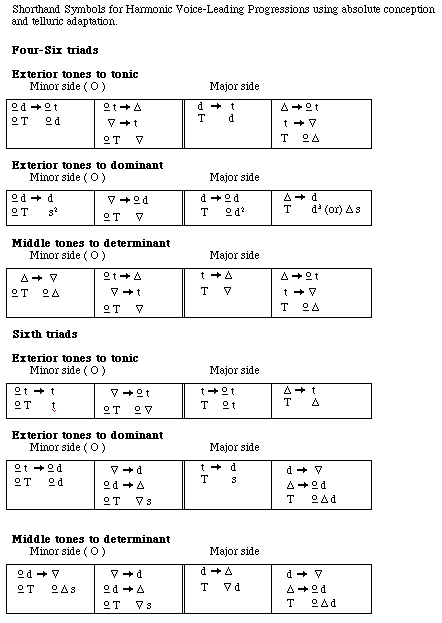
The table below (Example 7) is in shorthand symbolism and shows the progressions of triads and the change of function of the common tones. According to Levy:
“The general tendency of both triad inversions is that of the sixth to become a fifth as part of a new triad in fundamental position. The transformation hinges on one or two tones of the chord. There are six possible solutions for each inversion. A certain order of precedence exists, based in the first place on the greater ‘magnetizing power’ of the exterior tones, in the second place on the normal hierarchy of the functions tonic, dominant, and determinant.
In the sixth chord, C outranks E. Hence the primary tendency: C tends to become generator, t + → t o .
In the four-six chord, G outranks E. Hence the primary tendency: G tends to become generator, d → t .”
For clarification I would add the following. Even though there are six possible solutions for each of the two inversions (sixth chord and four-sixth chord with each solution yielding two variations), this only results in 20 different progressions (instead of 24) because four of the progressions are identical to others (see below). Following what has been quoted by Levy above the order reflects the following hierarchy (the direction of the tones are shown by theÍ or È symbols):
Since in the sixth chord in telluric adaptation (major triad), of the two exterior tones C outranks E (C being the tonic and E being the determinant), then the progression with C becoming the absolute conception tonic is first. This in effect determines the triads to be:
(È) E:G:C → (Í) C:Ab:F
The other exterior tone (i.e. E) becoming a tonic function is then listed next:
(È) E:G:C → (È) E:G#:B
Next would be these same exterior tones becoming a dominant function, beginning with C:
(È) E:G:C → (È) F:A:C
Then E:
(È) E:G:C → (Í) B:G:E
Finally the middle tone of this triad (i.e. G, being the dominant) would become a determinant, first becoming the telluric adaptation determinant (i.e. upward major third):
(È) E:G:C → (È) Eb:G:Bb
Then becoming the absolute conception determinant (i.e. downward major third):
(È) E:G:C → (Í) B:G:E
(note that this progression is a repeat of one of the others above)
Also in the sixth chord in absolute conception (minor triad), of the two exterior tones C outranks Ab (C being the absolute conception tonic and Ab being the absolute conception determinant), then the progression with C becoming the telluric adaptation tonic (the opposite of the above case) is first. This in effect determines the triads to be:
(Í) Ab:F:C → (È) C:E:G
The other exterior tone (i.e. Ab) becoming a tonic function is then listed next:
(Í) Ab:F:C → (Í) Ab:Fb:Db
Next would be these same exterior tones becoming a dominant function, beginning with C:
(Í) Ab:F:C → (Í) G:Eb:C
Then Ab:
(Í) Ab:F:C → (È) Db:F:Ab
Finally the middle tone of this triad (i.e. F, being the absolute conception dominant) would become a determinant, first becoming the absolute conception determinant (i.e. downward major third):
(Í) Ab:F:C → (Í) A:F:D
Then becoming the telluric adaptation determinant (i.e. upward major third):
(Í) Ab:F:C → (È) Db:F:Ab
(note that this progression is a repeat of one of the others above)
Since in the four-six chord in telluric adaptation (major triad), of the two exterior tones G outranks E (G being the dominant and E being the determinant), then the progression with G becoming the telluric adaptation tonic is first. This in effect determines the triads to be:
(È) G:C:E → (È) G:B:D
The other exterior tone (i.e. E) becoming a tonic function is then listed next:
(È) G:C:E → (Í) E:C:A
Next would be these same exterior tones becoming a dominant function, beginning with G:
(È) G:C:E → (Í) D:Bb:G
Then E:
(È) G:C:E → (È) A:C#:E
Finally the middle tone of this triad (i.e. C, being the tonic) would become a determinant, first becoming the telluric adaptation determinant (i.e. upward major third):
(È) G:C:E → (È) Ab:C:Eb
Then becoming the absolute conception determinant (i.e. downward major third):
(È) G:C:E → (Í) E:C:A
(note that this progression is a repeat of one of the others above)
Also in the four-six chord in absolute conception (minor triad), of the two exterior tones F outranks Ab (F being the absolute conception dominant and Ab being the absolute conception determinant), then the progression with F becoming the absolute conception tonic (the opposite of the above case) is first. This in effect determines the triads to be:
(Í) F:C:Ab → (Í) F:Db:Bb
The other exterior tone (i.e. Ab) becoming a tonic function is then listed next:
(Í) F:C:Ab → (È) Ab:C:Eb
Next would be these same exterior tones becoming a dominant function, beginning with F:
(Í) F:C:Ab → (È) Bb:D:F
Then Ab:
(Í) F:C:Ab → (Í) Eb:Cb:Ab
Finally the middle tone of this triad (i.e. C, being the absolute conception tonic) would become a determinant, first becoming the absolute conception determinant (i.e. downward major third):
(Í) F:C:Ab → (Í) E:C:A
Then becoming the telluric adaptation determinant (i.e. upward major third):
(Í) F:C:Ab → (È) Ab:C:Eb
(note that this progression is a repeat of one of the others above)
Keep in mind that what is normally called a minor triad is treated, in Levy’s theory, as a major triad generated from the top down. In other words there are only unisons, perfect fifths and major thirds in this theory. What would normally be called an F minor triad is a triad in absolute mode (designated by the symbol o ) generated by C. This would be spelled C-Ab-F (thinking downward from the generator C) and has the same interval structure as a C triad in telluric adaptation (i.e. C-E-G thinking up from C), so symmetrical reasoning is necessary for thinking in absolute conception. So in absolute conception C-Ab-F (thinking downward) is a triad in absolute conception ‘generated’ by C but thinking in telluric adaptation this same harmonic cell is a minor triad with F as the ‘tonic’. As I mentioned before all major telluric adaptation cells produce the same result as upward absolute conception so the ‘generator’ C would be identical with the ‘tonic’ C in this case (i.e. C-E-G thinking upward).
In all of the symbol sets below the top line of each set of symbols shows the function of the common tone within each harmonic cell. These triadic harmonic cells are referenced from a generator (not a tonic). If there are more than two lines of symbols, meaning there are two common tones, then the top two lines of symbols show the common tone functions and the top symbol line would be what is referenced in the headings above the table row (i.e. Exterior tones to tonic, Exterior tones to dominant and Middle tones to determinant). In all the symbol sets the first symbol of the bottom line shows if the first triadic cell is in telluric adaptation (major) or absolute conception (minor, or upside-down major), and the second symbol of the bottom line shows the relationship of the generator of the second triadic cell to the first triadic cell. In other words the second symbol of the bottom line shows which part of the first triadic cell (tonic, dominant, determinant or some other relation to these three functions) the second triadic cell is generated from (i.e. which part of the first triadic cell is the same tone as the generator of the second triadic cell).
Similar to the conception in Mathieu’s book “Harmonic Experience” the only intervals that are used in this thinking are powers of 2 (unison and octaves here called tonics or generators), powers of 3 (perfect 5ths, here called dominants), powers of 5 (major thirds, here called determinants), and later powers of 7 (dominant 7ths, here called natural 7ths). All other tones are derived from some combination of these four functions.
Using the second symbol group in the first line group below as an example (Four-Six triads – Exterior tones to tonic – Minor side – second group) the translation would be as follows:
[ Keep in mind that all of the symbols in the first three line groups have a four-six triad, either in absolute conception or telluric adaptation, as their first cell. This means that, in the key of C, the telluric adaptation for this cell would be identical with a standard triad in four-six inversion spelled G-C-E (upward thinking). Again in the key of C, the absolute conception of the four-six inversion is F-C-Ab (thinking downward from F). Note that this is the structure described by the first symbol in the last line of the second group (in the first line group below), however the generator of this cell is the tone C! The absolute conception may be slightly confusing at first. In terms of the four-six interval structure the cellular structure is designed thinking downward from F (i.e. F-C-Ab), however the root position triad is C-Ab-F (again thinking downward). Note that if you think of this same triad (i.e. Ab-C-F) in telluric adaptation you will find that it is a sixth chord (thinking upward from Ab), i.e. an F minor triad in second position. So this cell is a minor triad in telluric adaptation and that is why this symbol group falls on the ‘Minor side’ ]
In the first line o t describes a common tone that changes in function. The meaning is that the same tone that is the absolute tonic of the first triad (i.e. the generator of a downward triad) becomes the upward determinant (major third) in the second triad.
n the second line → t describes a second common tone that changes in function. The meaning here is that the same tone that is the absolute downward determinant in the first triad (i.e. a major third down from the generator) becomes the tonic (i.e. the generator) of the second telluric adaptation triad (which is an upward constructed triad).
The first symbol of the third line (i.e. o T ) describes the first triad, in this case it is a triad in absolute conception. The second symbol tells us that the second triad’s generator is the same tone as the absolute downward determinant of the first triad, however since there is no absolute conception symbol present here this alerts us that the second triad is built ‘upward’ (i.e. in telluric adaptation). This describes the following progression (the direction of the tones are shown by the Í or È symbols):
(Í) F:C:Ab → (È) Ab:C:Eb
Using the fourth symbol group in the first line group below as an example (Four-Six triads – Exterior tones to tonic – Major side – second group) the translation would be as follows:
In the first line → o t describes a common tone that changes in function, the tone that is the upward determinant of the first triad (i.e. the upward major third) becomes the absolute tonic (i.e. the generator) of the second absolute conception triad (i.e. the generator of a triad constructed downward).
In the second line t → describes a second common tone that changes in function. The same tone that is the tonic (i.e. the generator) in the first triad becomes the absolute downward determinant (i.e. a major third down from the generator) in the second triad, which is an triad in absolute conception (i.e. constructed downward).
The first symbol of the third line (i.e. T ) describes the first triad, in this case it is a triad in telluric adaptation (i.e. a normal upward triad). The second symbol o tells us that the second triad’s generator is the same tone as the upward determinant of the first triad. However since there is an absolute conception symbol, in front of the upward determinant symbol, this alerts us that the second triad is constructed in absolute conception (i.e. constructed downward). This describes the following progression (the direction of the tones are shown by the Í or È symbols):
(È) G:C:E → (Í) E:C:A
Using the first symbol group in the sixth line group below as an example (Sixth triads – Middle tones to determinant – Minor side – first group) the translation would be as follows:
In the first line o d → describes a common tone that changes in function, the tone that is the absolute downward dominant of the first triad (i.e. the subdominant) becomes the absolute downward determinant (i.e. downward major third) of the second triad.
The first symbol of the second line (i.e. o T ) describes the first triad, in this case it is a triad in absolute conception. The second symbol o s tells us that the second triad’s generator is the same tone as the upward determinant of the subdominant of the first triad (i.e. the absolute downward dominant). So the second triads generator is minor third below the first triad’s generator. Since there is an absolute conception symbol in front of the upward determinant symbol, this alerts us that the second triad is constructed in absolute conception. This describes the following progression (the direction of the tones are shown by the Í or È symbols):
(Í) Ab:F:C → (Í) A:F:D
In Example 7 the table is divided into two progressions each beginning with a minor triad (absolute conception) on the left side and two progressions each beginning with a major triad (telluric adaptation) on the right side.
Example 7
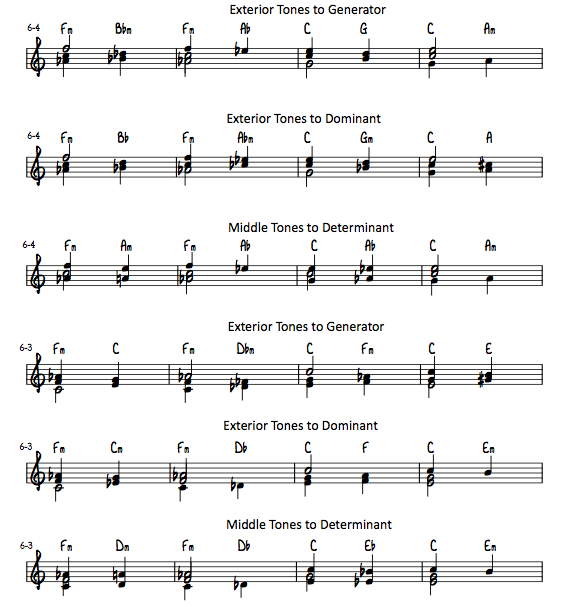
 The standard notation for the symbolic expressions above are as shown in Example 8 below in the same format, i.e. the first chord (four-six or sixth) of the first and second measures are in absolute conception (minor) and the first chord (four-six or sixth) of the third and fourth measures are in telluric adaptation (major):
EXAMPLE 8
Standard musical notation for Harmonic Voice-Leading Progressions using telluric adaptation and absolute conception.
On The Natural Seventh
On page 45 of “A Theory of Harmony” Levy states “for nearly three hundred years the interval of the minor seventh has been recognized as a dissonance different from all other dissonances. Whereas dissonances in general are produced by a tone or tones disturbing a chord, and may therefore be resolved within that chord, the seventh is an integral part of a chord to be resolved as a whole into another chord. A dissonant tone is understood as a function of a chord; a dissonant chord, as a function of another chord. The seventh confers a definite function to the chord of which it is a part”.
Here Levy makes two statements that set up the rest of his discussion on natural sevenths:
a) the minor seventh added to a major triad characterizes it as a dominant;
b) the minor seventh added to a minor triad in absolute conception characterizes it as
a subdominant:
As an example I used saxophonist Charlie Parker as my model when first learning how to improvise. Being basically self-taught I remember the initial steps that I took in learning how to distinguish tonal functions. I generally recognized chords as having one of two functions, stationary and changeable (or fixed and mutable). Chords that had a dominant function I considered changeable, they sounded like they were going somewhere. For example I looked at the fourth measure of a blues as “going to IV” (the IV referring to the dominant seventh chord based on the fourth degree of the key of the blues). Then there were certain melodic sounds that I would hear Charlie Parker play that I associated with “going to IV.” I also remember other sounds that I called “minor iv to I”, “minor vi to I” and so on. These sounds were based on, respectively, a minor seventh chord built on the subdominant degree of the destination tonality and a minor seventh chord built on the flatted sixth degree of the destination tonality.
I instinctively knew that all of these sounds could be played in place of a normal dominant to tonic chord progression. I also knew that there was something different in the feel of “minor iv to I” and “minor vi to I”. Even though I could see that it was a substitute for a dominant function I also knew that the normal dominant sound was ‘bright’ and the “minor iv to I” and “minor vi to I” sounds were darker functions. Not because there was minor tonality involved, the progression itself was ‘dark’ in relation to the tonic tonality. I realize now that what I was hearing was the difference (implied by the equal temperament tuning system) between ‘overtones’ and ‘undertones’, the latter being ‘darker’ in sound in relation to the ‘generator’ tonality or fundamental tonality. The minor seventh chord in ‘absolute conception’ definitely has an ‘undertone’ quality to it, despite equal temperament tuning as our ears tend to compensate for this anyway (more on this later). We will see that it is the dominant seventh chord in ‘absolute conception’ with the tonic of the key as generator which can be substituted for the dominant 7th chord in ‘telluric adaptation” built on the fifth degree of this same tonic. In other words, in the key of G, G:Eb:C:A (in absolute conception , i.e. thinking downward) can be substituted for D:F#:A:C (in telluric adaptation, i.e. thinking upward). In the case of the G7 chord in absolute conception the ‘undertones’ represent the fundamental (or generator), 5th partial, 3rd partial and 7th partial respectively. In the case of the D7 chord in telluric adaptation the ‘overtones’ represent the 3rd partial, 15th partial (i.e. 3 times 5), 9th partial (two fifths up) and the 21st partial (i.e. 3 times 7). So one chord is all ‘undertone’ energy and the other is all ‘overtone’ energy. This may be apparent in this case but things go much farther, as will be seen later. As will be discussed later the ‘overtone’ energy can generally be associated with the Sun and with brightness, the ‘undertone’ energy with the Moon and with darkness.
Ernst Levy then goes on to prove how the minor seventh tone that he is referring to represents the seventh partial of the harmonic series (in other words representing the ratio 7:4 as opposed to the ratios 9:5 or 16:9, which are also minor 7ths. Conversely the ‘undertone’ minor 7th is represented by the ratio 4:7, or 8:7 octave reduced). To keep things moving I will skip this discussion of the tuning of the natural seventh, interested readers will find this discussion on pages 45 and 46 of Levy’s “A Theory of Harmony”. What I am going to discuss is what is happening from the standpoint of progressions using these symmetrical ideas.
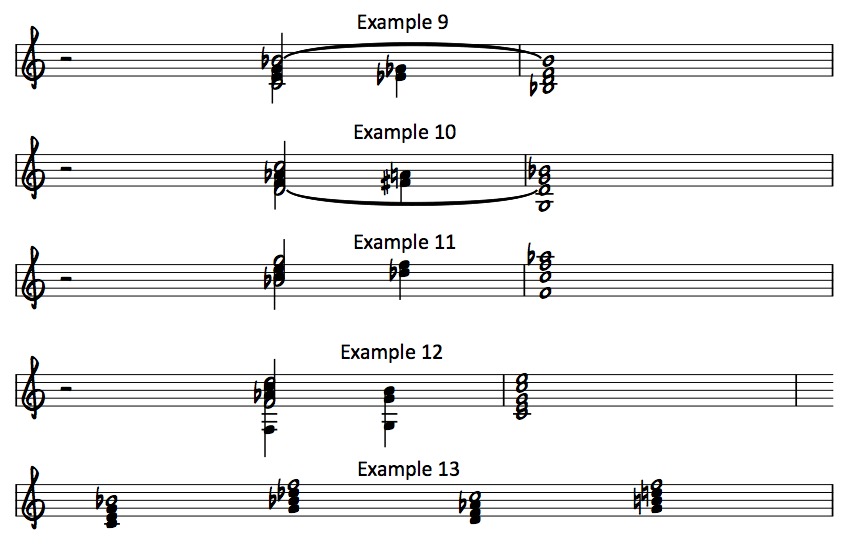
On page 48 of “A Theory of Harmony” Levy shows the following progression (Examples 9 through 13):
From this point on I will use the negative sign when speaking of chords in abosolute conception, e.g. G7 in absolute conception will be written as -G7.
In example 9 we are in the key of Bbmaj. Here the three chords function as positive secondary dominant, negative dominant, positive tonic (C7 to -Bb7 to Bbmaj).
In example 10 we are in the key of -Dmaj. Here the three chords function as negative secondary dominant, positive dominant, negative tonic (-C7 to D7 to -Dmaj).
In example11 we are in the key of -Cmaj. Here the three chords function as positive dominant, negative dominant, negative tonic (C7 to -F7 to -Cmaj).
In example 12 we are in the key of Cmaj. Here the three chords function as negative dominant, positive dominant, positive tonic (-C7 to G7 to Cmaj).
In example 13 different dominant 7th chords are shown, C7, -F7, -C7, G7. It can be seen that each of the negative chords represent an extension or top part of the positive chords. Each absolute conception dominant 7th chord is the negative counterpart of a telluric adaptation dominant 7th chord and you can see that both negative and positive chords are part of the same dominant complex. For example the positive = C7 while the negative = -F7. Both dominant 7th chords share two tones, G and Bb. The -F7 can be thought of as an upper extension of the C7. In fact this entire dominant 7th complex would be traditionally called a C11 b9 chord. Both dominant chords most naturally go to a tonic chord with F as the root, C7 -> Fmaj and -F7 -> -Cmaj, so they both progress to parallel tonic chords, e.g. they both progress to tonic chords which have the same root but different polarities! I call the chords ‘parallel tonic chords because they sound out parallel worlds of tonality and we know that in traditional music theory F minor is the parallel minor to F major. The -C7 and G7 chords are in the same relationship to each other.